Crosstela LearnНавчання Get the appЗавантажити застосунок

LearnStart stitching

How many strands of floss for cross stitch?

Use 2 of the 6 strands for cross stitch on 14-count Aida, and 1 for backstitch. Use 3 strands on 11-count, 2 on 16- and 18-count, 1 on 22-count, and 2 on 28- or 32-count evenweave stitched over two. When the chart's key gives a number, follow the key.
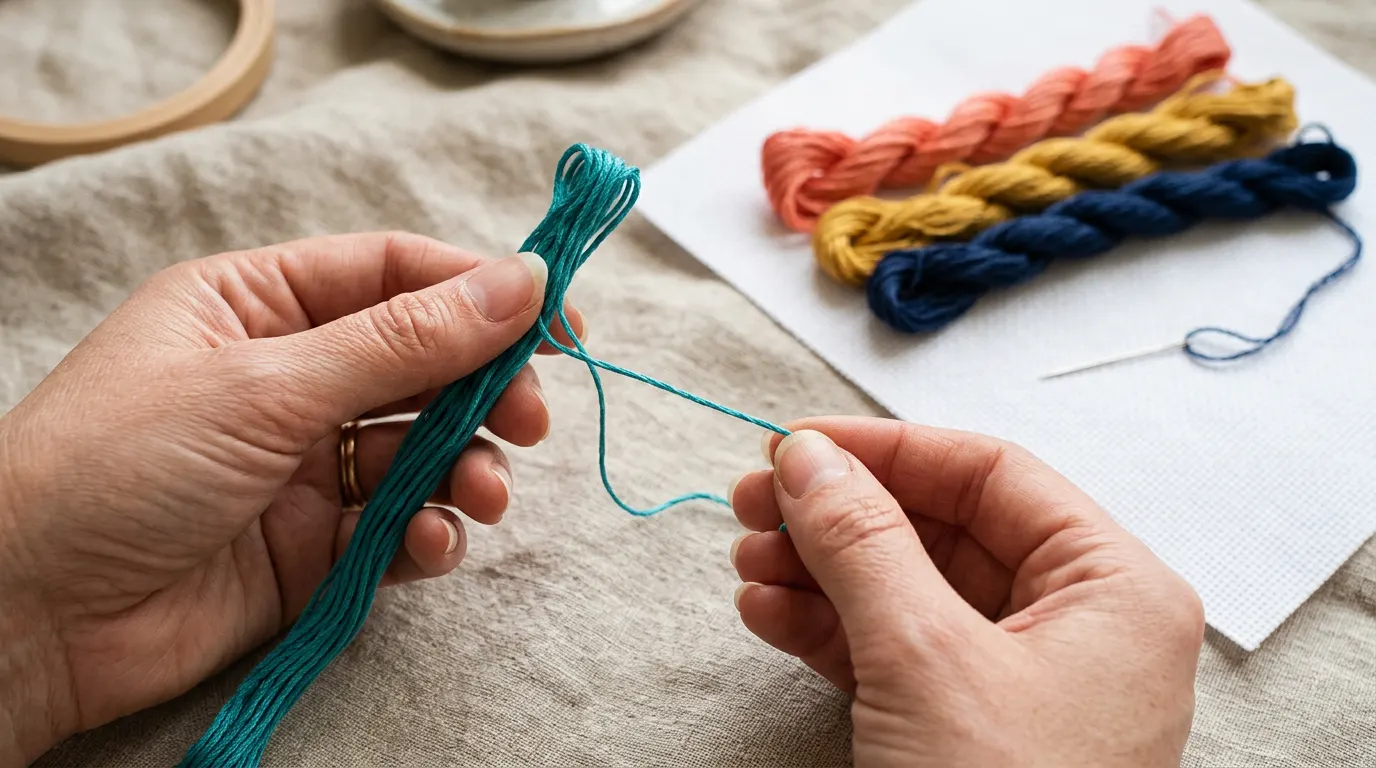
Two hands pull a single strand of teal embroidery floss out of a six-strand length, with coral, mustard and navy floss on white Aida beside them.
On this page
  1. Strands by fabric count
  2. The chart’s key comes first
  3. More or fewer strands
  4. How to separate strands
  5. Other threads
  6. Strands and the floss you will need
  7. In the app
  8. Your next step
  9. Questions people ask

Six-strand embroidery floss (stranded cotton: DMC, Anchor, Gamma and the rest) is made to be split. You choose how many strands go into the needle, and that choice decides how full and smooth your crosses look.

Strands by fabric count

FabricStitches per inchCross stitchBackstitch
Aida 6 to 86–843
Aida 10, 1110–1132
Aida 141421
Aida 161621
Aida 18182 (1 for a lighter look)1
Aida 20, 2220–2211
Evenweave or linen 25–36, over two12.5–1821
Linen over one, or 40-count over two20 or more11

The rule underneath is simple: the smaller the squares, the fewer strands fit through the holes. For backstitch, a common default is one strand fewer than the crosses, but never fewer than one; when the designer’s key gives a number, the key wins. This default is also what Crosstela uses when a pattern does not say.

For what each count means and the needle that suits it, see Aida and other fabric counts.

The chart’s key comes first

Designers often write the strands in the key, such as 2 strands cross stitch, 1 strand backstitch, or give a different number for one colour, for French knots, or for a blend. Their number was chosen for that design, so follow it over any table, including this one.

Two other things a key may ask for:

  • A blend: one strand each of two colours in the same needle, to make a shade between them.
  • Half stitches in one strand: a light, see-through layer for skies and shadows.

More or fewer strands

How many strands is partly taste. Coverage is how much of the fabric your crosses hide.

  • More strands give full, rich crosses that hide the fabric. Too many crowd the holes, the stitches look lumpy, and Aida can distort.
  • Fewer strands give a lighter, flatter look with the fabric showing through. Some stitchers like 1 strand on 18-count for a delicate piece.
  • Dark fabric shows through gaps more, so you may want the fuller choice.
  • Your tension matters too: a gentle pull lets strands spread and cover more.

Not sure? Stitch three or four crosses in a corner of the fabric with 2 strands and with 3, and look at them from arm's length.

How to separate strands

Even when you stitch with 2 strands, take them out one at a time and put them back together. Separated strands lie side by side instead of twisted, so they cover better and lie flat. Stitchers call this stripping the floss.

  1. Cut a length about 45 cm (18 in) long, roughly forearm to fingertips.
  2. Pinch the six strands at one end between finger and thumb. Fan the very end a little so you can see each strand.
  3. Hold the bundle and pull one strand straight up and out, slowly. The rest bunches up below your fingers; that is fine.
  4. Let the bundle hang for a moment and it untwists itself. Pull the next strand.
  5. Lay the strands you need next to each other, ends even, and thread them together.

Pulling two strands at once, or pulling sideways, is what makes the rest knot. If they tangle, let the bundle hang and the twist will run out. Keep the leftover strands on a card or bobbin with the colour number, so you can use them later.

Other threads

The table is for six-strand cotton. Other threads work differently:

  • Pearl cotton (coton perlé) cannot be split; it is used as a single thread on larger fabric.
  • Metallic and blending filament are usually stitched as one strand, often together with a strand or two of cotton.
  • Wool and silk have their own weights; follow the key or the thread maker’s advice.

Strands and the floss you will need

More strands use more floss. Two strands use twice as much as one, so a chart stitched in 3 strands on 11-count needs far more skeins than the same chart in 2 strands on 14-count. The skeins calculator takes your count and your strands into account.

In the app

In Crosstela, press and hold a colour on the rail beside the chart, or in the Palette. Its menu shows Strands with the number in force, such as Strands · 2: the number the pattern gives, or yours. Choose from 1 to 6 to set your own for that colour; the item that says as the pattern takes yours back. See Stitch one colour at a time.

Crosstela is free, for iPhone, iPad and Mac.

Your next step

Look at the key of the chart you are about to stitch: it says how many strands to use for crosses and for backstitch. If it says nothing, use the table above for your cloth. Then work out how many skeins to buy with the skein calculator.

Questions people ask

How many strands do you use for cross stitch on 14-count Aida?

Two strands for the crosses and one for backstitch. That is the usual choice and the one most kits on 14-count use.

How many strands for 18-count Aida?

Two strands give full coverage; one gives a lighter, more delicate look. Backstitch is one strand.

How many strands for 28-count evenweave?

Stitched over two threads, 28-count gives 14 stitches to the inch, so use 2 strands, as on 14-count Aida. Over one, use 1.

Why separate all six strands if I only need two?

Separated strands lie flat and side by side, so the crosses look smoother and cover the fabric better than two strands still twisted together.

Do I use the same number of strands for backstitch?

Usually one fewer than for the crosses, often a single strand. The chart's key may say otherwise for an outline that should stand out.

НавчанняПерші кроки

У скільки ниток вишивати хрестиком?

На Аїді 14 хрестики вишивають у 2 нитки мулине з шести, а бекстіч — в 1. На Аїді 11 беруть 3 нитки, на 16 і 18 — 2, на 22 — 1, а на рівномірці 28 чи 32 через дві нитки — 2. Якщо кількість ниток указано в ключі схеми, слухайтеся ключа.

Дві руки витягують одну ниточку бірюзового мулине з шестиниткового пасма; поруч на білій Аїді лежать коралове, гірчичне й темно-синє мулине.
На цій сторінці
  1. Таблиця за каунтом канви
  2. Спершу — ключ схеми
  3. Більше чи менше ниток
  4. Як розділити мулине на нитки
  5. Інші нитки
  6. Нитки й кількість мотків
  7. У застосунку
  8. Ваш наступний крок
  9. Часті питання

Мулине (DMC, Anchor, Гамма та інші) складається з шести тонких ниточок, і його задумано ділити. Ви самі вирішуєте, скільки ниток вдягти в голку, і від цього залежить, наскільки повними й рівними вийдуть хрестики.

Таблиця за каунтом канви

КанваХрестиків на дюймХрестикиБекстіч
Аїда 6–86–843
Аїда 10, 1110–1132
Аїда 141421
Аїда 161621
Аїда 18182 (1 — для легшого вигляду)1
Аїда 20, 2220–2211
Рівномірка чи льон 25–36 через дві нитки12,5–1821
Льон через одну нитку або 40 каунт через дві20 і більше11

Правило просте: що дрібніші клітинки, то менше ниток вміщується в дірочки. Для бекстічу поширений типовий вибір — на одну нитку менше, ніж для хрестиків, але не менше ніж одна; якщо ключ дизайнера вказує число, слухайтеся ключа. Так само робить і Crosstela, коли схема не вказує кількість ниток.

Що означає кожен каунт і яка голка до нього пасує — у статті Аїда та інші каунти канви.

Спершу — ключ схеми

Дизайнери часто пишуть кількість ниток у ключі, наприклад хрестик у 2 нитки, бекстіч в 1, або дають інше число для окремого кольору, для французьких вузликів чи для змішаних ниток. Це число підібрано саме для цього дизайну, тож слухайтеся його, а не будь-якої таблиці, і цієї теж.

Ще дві речі, які може вказати ключ:

  • Змішування (бленд): по одній ниточці двох кольорів в одній голці, щоб вийшов відтінок між ними.
  • Півхрестики в одну нитку: легкий, напівпрозорий шар для неба й тіней.

Більше чи менше ниток

Кількість ниток — почасти справа смаку. Покриття — це те, наскільки хрестики закривають канву.

  • Більше ниток дають повні, насичені хрестики, крізь які канви не видно. Забагато — і дірочки забиваються, хрестики стають горбкуватими, а Аїда може перекоситися.
  • Менше ниток дають легший, пласкіший вигляд, і канва просвічує. Дехто любить одну нитку на Аїді 18 для ніжної роботи.
  • Темна канва сильніше видна крізь проміжки, тож на ній краще взяти більше ниток.
  • Натяг теж важить: коли не затягувати, нитки розходяться й краще вкривають канву.

Сумніваєтеся? Вишийте в куточку канви три-чотири хрестики у 2 нитки й стільки ж у 3 і подивіться на них з відстані витягнутої руки.

Як розділити мулине на нитки

Навіть коли вишиваєте у дві нитки, витягуйте їх по одній, а тоді складайте разом. Розділені нитки лягають поруч, а не скручені, тож краще вкривають канву й лежать рівно.

  1. Відріжте шматок близько 45 см — приблизно від ліктя до кінчиків пальців.
  2. Затисніть шість ниточок з одного кінця між великим і вказівним пальцями. Трохи розпушіть самий кінчик, щоб бачити кожну ниточку.
  3. Тримаючи пасмо, повільно витягніть одну ниточку прямо вгору. Решта збереться гармошкою під пальцями — так і має бути.
  4. Дайте пасму повисіти: воно саме розкрутиться. Витягніть наступну ниточку.
  5. Складіть потрібні ниточки поруч, кінцями врівень, і вдягніть у голку разом.

Мулине заплутується, коли тягнути дві ниточки одразу або тягнути вбік. Якщо заплуталося, дайте пасму повисіти, і скрутка розійдеться. Зайві ниточки намотайте на картонку чи бобінку з номером кольору — знадобляться.

Інші нитки

Таблиця — для шестиниткового бавовняного мулине. З іншими нитками інакше:

  • Перле (coton perlé) не ділиться; ним вишивають в одну нитку на крупнішій канві.
  • Металізовані нитки й блендинг-філамент зазвичай кладуть в одну нитку, часто разом з однією-двома ниточками бавовни.
  • Вовна й шовк мають свою товщину; слухайтеся ключа або порад виробника ниток.

Нитки й кількість мотків

Що більше ниток, то більше мулине. Дві нитки витрачають удвічі більше, ніж одна, тож схема у 3 нитки на Аїді 11 потребує значно більше мотків, ніж та сама схема у 2 нитки на Аїді 14. Калькулятор мотків враховує і каунт, і кількість ниток.

У застосунку

У Crosstela натисніть і утримуйте колір на шкалі збоку схеми або в Палітрі. У його меню є пункт Ниток у голці з числом, що діє зараз, наприклад Ниток у голці · 2: так, як указано у схемі, або ваше власне. Виберіть від 1 до 6, щоб задати своє число для цього кольору; пункт зі словами як у схемі поверне число зі схеми. Див. Вишивайте один колір за раз.

Crosstela безкоштовна, для iPhone, iPad і Mac.

Ваш наступний крок

Подивіться на ключ схеми, яку збираєтеся вишивати: він каже, у скільки ниток вишивати хрестики й бекстіч. Якщо не каже, скористайтеся таблицею вище для вашої канви. Потім порахуйте, скільки мотків купувати, калькулятором муліне.

Часті питання

У скільки ниток вишивати хрестиком на Аїді 14?

Хрестики — у дві нитки, бекстіч — в одну. Це звичний вибір, і на ньому побудовано більшість наборів на Аїді 14.

У скільки ниток вишивати на Аїді 18?

Дві нитки дають повне покриття, одна — легший, ніжніший вигляд. Бекстіч — в одну нитку.

У скільки ниток вишивати на рівномірці 28?

Через дві нитки рівномірка 28 дає 14 хрестиків на дюйм, тож беріть 2 нитки, як на Аїді 14. Через одну нитку — 1.

Навіщо розділяти всі шість ниток, якщо потрібні лише дві?

Розділені нитки лягають рівно й поруч, тож хрестики виходять гладкішими й краще вкривають канву, ніж дві нитки, що лишилися скрученими.

Бекстіч вишивають у стільки ж ниток?

Зазвичай на одну менше, ніж хрестики, часто в одну нитку. Ключ схеми може вказати інакше для контуру, який має виділятися.