LearnStart stitching
Cross-stitch glossary
This glossary explains the words cross stitchers use for fabric, thread, stitches, charts and techniques, from Aida and count to parking, confetti and FFO. Each term has a short, plain definition, with a link to a fuller guide where there is more to learn.
On this page
Cross stitch has its own vocabulary, and much of it is shorthand from forums and kits. Here are the terms you will meet most, grouped by subject.
Fabric
Aida
A cotton cloth woven in small blocks with a hole at each corner, made for cross stitch. Each block takes one cross, so you can see exactly where every stitch goes.
Count
How fine the cloth is. On Aida it is the squares to the inch, one cross in each: 14-count Aida takes 14 crosses to the inch, about 5.5 to the centimetre. On evenweave and linen it is the cloth’s threads to the inch; stitched over two, that gives half as many stitches, so 28-count linen over two takes 14 to the inch. A higher count gives a smaller, finer result.
Evenweave
A cloth of single threads of even thickness, the same number each way. It is usually 25 to 32 count and stitched over two.
Linen
Cloth woven from flax. Its threads vary in thickness, which gives it a natural look but makes counting harder. It is stitched over two, like evenweave.
Over two
Each cross covers two threads of the cloth each way. On 28-count evenweave, over two gives 14 stitches to the inch, the same size as 14-count Aida.
Thread
Floss
Embroidery thread, usually six-strand cotton, sold by brands such as DMC, Anchor and Gamma under numbered shades. A pattern names the brand and number for every colour.
Strands
The six thin threads that make up floss. You separate them and stitch with one, two or three, depending on the count: two is usual on 14-count Aida.
Skein
The small bundle floss is sold in, held by paper bands that give the brand and shade number. A DMC six-strand skein holds 8 metres.
Bobbin
A flat card of plastic or cardboard that floss is wound onto, with its shade number written on it, so threads stay sorted and untangled.
Blended needle
Two different shades in one needle, often one strand of each, to make a colour in between. The key lists both numbers in one row.
Needles and frames
Tapestry needle
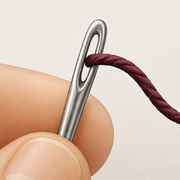
A needle with a blunt tip and a long eye, made for counted cloth. A higher number is a finer needle: 24 for 14-count Aida, 26 for 16- and 18-count.
Hoop
Two rings, usually of wood or plastic, that hold the cloth taut between them; the outer one tightens with a screw. Take the cloth out when you stop for the day to avoid ring marks.
Q-snap
A square or rectangular frame of plastic tubes, with clips that snap over the cloth. It holds the cloth taut and presses less on finished stitches than a hoop.
Scroll frame
A frame with two rollers: the cloth is rolled onto them, so a large piece stays taut and only the part you are working on is open.
Stitches
All of these are described step by step in the stitch library.
Full cross
The basic stitch: two diagonal stitches crossing in one square. Every top leg in a piece should lie the same way.
Half stitch
One diagonal leg of a cross, across a whole square. It gives a lighter texture for shading, skies and backgrounds.
Quarter stitch
A diagonal stitch from one corner of a square to its centre. It fills part of a square, usually where two colours meet.
Three-quarter stitch
A half stitch and a quarter stitch in the same square. It smooths curves and diagonal edges; charts often draw it as a triangle filling half the square.
Petite stitch
A tiny cross in one quarter of a square. On Aida the needle pierces the middle of the block. It is used for fine detail such as eyes.
Backstitch
Straight stitches from hole to hole that make outlines and lettering, usually worked after the crosses and often with one strand.
French knot
A small raised knot made by wrapping the thread round the needle and going back down next to where it came up. It makes eyes, dots and flower centres.
Bead
A small glass bead sewn onto a square with a thin beading needle. Beads go on after the stitching around them.
Specialty stitch
Any stitch beyond crosses and backstitch, such as an Algerian eye, a Smyrna cross or satin stitch. Charts explain each on a page of its own.
Charts
Chart
The pattern as a grid of squares, one per stitch, with a symbol or colour in each and a key that names the threads.
PDF pattern
A chart sold or shared as a PDF file, usually with a cover page, the key and the chart split across pages. Crosstela opens PDF patterns saved by a design program and lets you mark each stitch as you go; a scan or photo of a paper chart is not read. See Track a PDF pattern.
Key
The table that says which thread each symbol stands for, with brand, shade number and strands, and often how many skeins you need. Also called the legend.
Symbol
The mark in a chart square that stands for one thread. A black-and-white chart relies on symbols alone; a colour chart adds colour behind them. See how to read a pattern.
Tens lines
The bolder grid lines every ten squares. They make counting easier. In Crosstela, Tools › Grid draws lines every five or ten squares and marks the centre.
Full coverage
A design in which every square is stitched and no bare cloth shows. Full-coverage charts are often made from paintings and have many colours and much confetti.
Confetti
Single stitches of one colour scattered among other colours. It is common in full-coverage and photo-based patterns; see turn a photo into a pattern.
Techniques
Loop start
A way to start without a knot: fold one strand in half, thread both ends through the needle, make the first half stitch and pass the needle through the loop on the back. It works for an even number of strands.
Waste knot
A knot made on the front of the cloth a few centimetres from your first stitch, in line with the row you will stitch. The stitches cover its thread on the back; when they reach the knot, you cut it off.
Away knot
A knot made on the front well away from where you will stitch, so no stitch covers its thread. When the area is done, you cut the knot off and weave the tail in under a few stitches on the back.
Tails
The short ends of thread left at the back when you start or finish. They are covered by stitches or run under them, not knotted.
Gridding
Running a thin thread, or using a washable pen, along every tenth line of the cloth to match the chart's tens lines. The thread comes out when the stitching is done.
Parking
Stitching in small blocks and, when a colour is done in one block, bringing its needle up where that colour starts next and leaving it there. It keeps many colours going without long threads across the back. See the parking method; in Crosstela you can park a thread on the chart.
Cross-country
Stitching one colour across a whole area before changing to the next. It suits patterns with large patches of colour.
Railroading
Passing the needle between the two strands of a stitch so they lie flat, side by side, instead of twisting. It takes a little longer and gives smoother coverage.
Frogging
Unpicking stitches. The name comes from "rip it, rip it", which sounds like a frog.
Community words
BAP
"Big ass project": a very large chart, often full coverage, that takes months or years.
HAED
Heaven and Earth Designs, a pattern company known for very large full-coverage charts made from paintings and art.
WIP
Work in progress: a project started and not yet finished. Many stitchers keep several WIPs and rotate between them.
FFO
Fully finished object: stitched and made up, framed or sewn into a cushion or an ornament. An FO, finished object, has its stitching done but is not yet made up.
SAL
Stitch-along: a group stitches the same pattern on a shared schedule, often with parts released one at a time, and shares progress.
Stash
The threads, cloth, patterns and kits a stitcher keeps for future projects.
Questions people ask
What does 14-count mean in cross stitch?
On Aida it means 14 squares, so 14 crosses, to the inch, about 5.5 to the centimetre. A design 140 stitches wide comes out 10 inches (25.4 cm) wide on 14-count.
What is the difference between Aida and evenweave?
Aida is woven in blocks with clear holes, and each cross covers one block. Evenweave has single, even threads and is usually stitched over two, which gives a finer look and allows fractional stitches more easily.
What is confetti in cross stitch?
Confetti means single stitches of one colour scattered among other colours. Each one needs its own start and finish, so stitchers often work it with the parking method.
What do WIP, FFO and SAL mean?
WIP is a work in progress, FFO a fully finished object (stitched and made up), and SAL a stitch-along, where a group stitches the same pattern on a shared schedule.